
How Virtual Showrooms for Manufacturers Show More Products Without More Floor Space
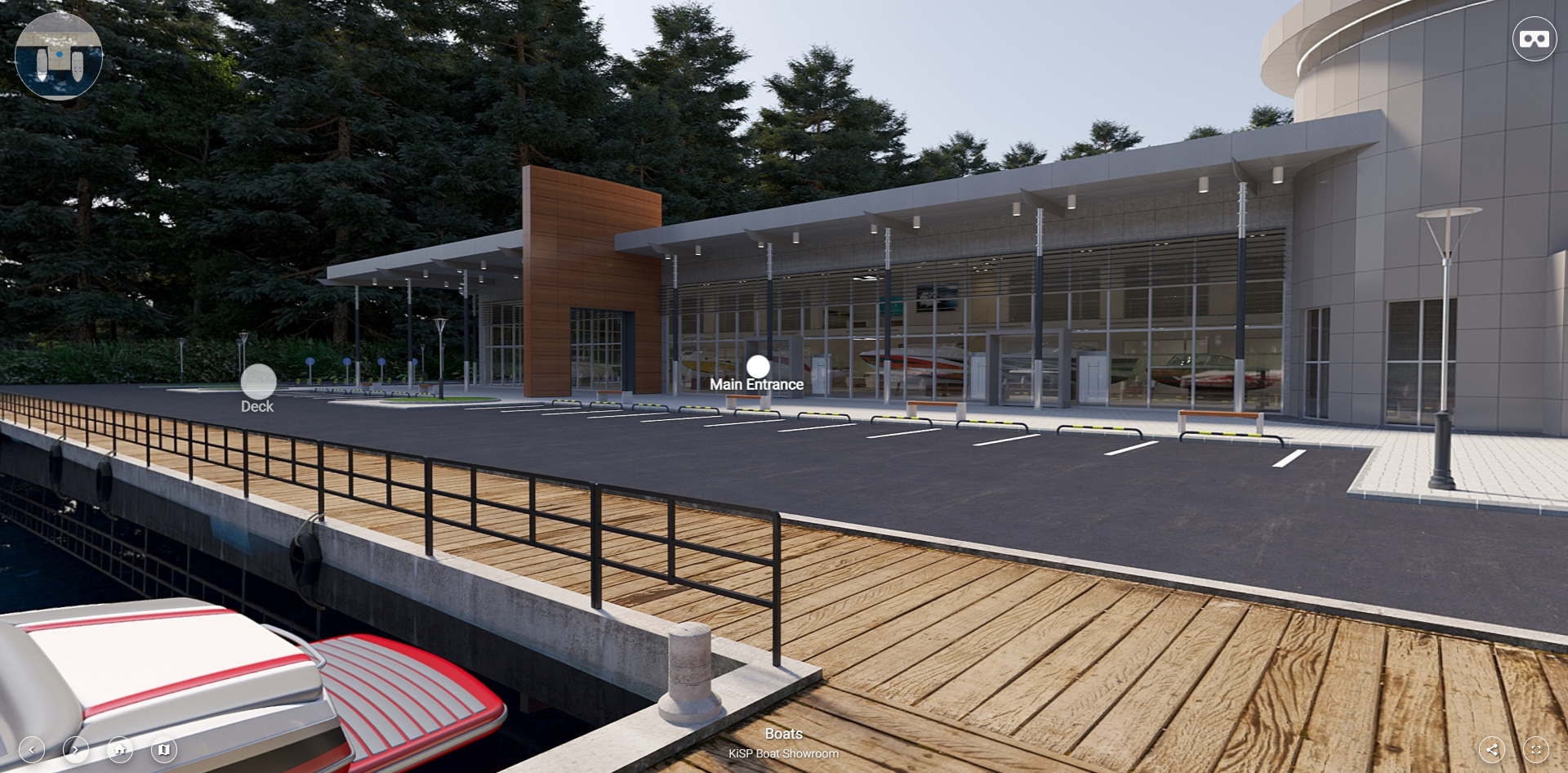
A physical showroom can only show so much. There is only so much floor space, only so much inventory available at one time, and the exact model, finish or configuration a customer wants to see may be somewhere else entirely.
For manufacturers and dealers with large or complex product lines, that creates a familiar challenge: how do you show customers everything you offer when you cannot physically put it all in front of them?
Virtual showrooms for manufacturers give you another way. Instead of trying to re-create a physical showroom online, manufacturers can build an interactive digital environment that expands what customers and sales teams are able to see, explore and discuss.
And unlike a physical showroom, it can be available 24/7 from almost anywhere.
What Is a Virtual Showroom?
A virtual showroom is an interactive digital environment where customers can explore products in a realistic, branded space.
Depending on the project, the experience can be created using 3D product models, rendered environments, 3D photography of an existing location, or a combination of approaches.
Visitors can move between products and spaces while accessing supporting content such as:
- Product images and renderings
- Video
- Text and specifications
- Audio
- Navigation hotspots
- Floorplans
- Augmented reality objects
A useful virtual showroom helps customers understand your products and gives sales teams more ways to present them.
Show More Products Without Building a Bigger Showroom
For many manufacturers, the most obvious benefit is space. A dealership or showroom can only accommodate part of a large product line. Even when a customer visits in person, the exact product being discussed may not be available at that location. A virtual product showroom opens that up.
Different models, configurations, finishes and product families can live within the same digital experience without requiring more physical floor space. That makes the showroom useful both before and after a customer visits in person.
A prospect researching online can explore products on their own schedule, while a salesperson can use the same environment during a conversation when the product the customer wants to see is not physically on the floor.
Create the Environment Your Products Deserve
Physical product photography comes with its own set of limits. The product has to be available. It has to be moved to the right location. Lighting, weather and season all matter. Once the photography is complete, changing the environment can mean starting again.
3D visualization gives manufacturers far more control. A product can be presented in the setting that best supports its story, with the right lighting, surroundings and context, while the product itself remains accurate.
That is especially valuable when the environment is part of how customers imagine the product. A boat, for example, is not experienced in a warehouse. The water, marina, light and surrounding landscape all contribute to how the product feels.
The same principle applies across industries. Furniture can be shown in a completed workplace or learning environment. Equipment can be shown where it will actually be used. Products that do not yet physically exist can still be presented in context.
The showroom becomes more than a digital version of a building. It becomes an idealized sales environment.
Malibu Boats: Extending the Showroom Beyond the Dealership
Malibu Boats came to KiSP with an existing virtual showroom, but the experience did not reflect the premium quality of the boats themselves.
The environment had a more stylized, video-game feel, and Malibu wanted something more photorealistic and polished. There was also a practical challenge. Malibu works through a dealer network, and individual locations can have very different inventory, branding and showroom requirements. A single fixed digital showroom would not necessarily reflect what every dealer sold.
KiSP developed a more flexible approach.
The virtual showroom program could be adapted around individual dealerships, incorporating dealer inventory, logos, corporate colours and supporting content while maintaining a consistent level of quality. Larger dealer experiences were scoped to accommodate up to 50 boats, with smaller versions supporting up to 25.
That gave dealers a way to show far more of the Malibu product line than could realistically fit on a physical showroom floor.
From Indoor Showroom to Open Water
The digital environment also created opportunities that would be difficult to reproduce physically. Customers could move through the showroom, explore individual boats and then experience products in waterfront settings that helped communicate how they would actually be used. Instead of being limited by the weather, season or location of a photography session, rendered products could appear in ideal conditions.
The experience could also include interactive product content such as rendered imagery, video, text and audio. For customers, that creates more ways to explore a product. For salespeople, it provides somewhere useful to take the conversation when a customer asks about a different model, layout or configuration that is not sitting on the lot.
One Showroom Does Not Have to Fit Every Dealer
One of the most useful lessons from the Malibu project is that a virtual showroom does not have to be a single corporate experience that every dealer uses in exactly the same way.
The underlying environment can provide consistency while the content changes around the needs of a location.
Inventory can vary, branding can vary, and the amount of supporting content can vary.
The way the showroom is built can vary too. Where accurate 3D product models are available, a fully rendered environment offers the most flexibility. Where an existing physical location is important to the customer experience, 3D photography can be used to create a navigable digital version of that showroom and enhanced with interactive content.
The right approach depends on what the business needs the showroom to accomplish.
Turn a Virtual Showroom Into a Sales Tool
The strongest virtual showrooms do more than give prospects something to browse.
They support the sales process. A salesperson can use a virtual environment during an in-person or remote meeting to move quickly between products, applications and supporting information. A customer can then return to the same experience after the meeting and continue exploring independently.
This is particularly useful for manufacturers with:
- Large product portfolios
- Multiple configurations or finishes
- Dealer networks
- Products that are difficult or expensive to transport
- Products sold across large geographic territories
- New products that need marketing before physical inventory is widely available
The value is not simply that customers can see something in 3D.
It is that your sales team has more to show.
Your 3D Product Assets Can Do More Than One Job
A virtual showroom can also become part of a broader visual marketing strategy.
Once accurate product models have been prepared for visualization, those assets can often support additional content such as:
- Photorealistic product renderings
- Launch imagery
- Animation
- Augmented reality experiences
- Dealer marketing materials
- Trade-show displays
- Interactive sales content
- Social and digital campaigns
Instead of commissioning every visual from scratch, manufacturers can build a library of accurate digital assets that continue to support new marketing and sales applications.
That changes the conversation from simply asking what a virtual showroom costs to asking what your product assets could be doing for you.
Virtual Showrooms Are Not Meant to Replace Physical Ones
For most manufacturers, the goal should not be to eliminate the physical showroom.
There is still enormous value in seeing, touching and experiencing a product in person.
A virtual showroom extends that experience. It gives customers somewhere to begin before they visit, gives salespeople somewhere to take the conversation when the right product is not available, and gives customers somewhere to return after a meeting. It also allows manufacturers and dealers to show a broader range of products without increasing physical inventory or floor space.
The physical and digital experiences work best together.
What Could Your Showroom Look Like?
Your physical showroom has limits. Your product line does not have to. A photorealistic virtual showroom can give customers access to more products, more information and more ways to explore, while giving your sales team a tool that is available 24/7 from anywhere.
And a virtual showroom may be more affordable than you think.
See what KiSP can build for your products.
Explore our Virtual Showroom services or contact the KiSP Visualizations team at renderings@kisptech.com to start a conversation.